Science
At Rockwell Green Primary School, we believe learning in science is fundamental to understanding the world in which we live. It helps to clarify ideas, to ask questions, to test explanations through measurement and observation, and to use these findings to establish the worth of an idea.
We place a high level of importance on ensuring our pupils are innovative life-long learners in Science.
Our curriculum involves pupils investigating their environment and making sense of it in logical and creative ways. Children at our school learn to choose and use appropriate materials and resources safely. We understand child-led investigations are important to allow children to gain skills in questioning and thinking to further their scientific knowledge.
OUR AIMS - INTENT
The aims of Science are:
- to develop pupils’ enjoyment and interest in science and an appreciation of its contribution to all aspects of everyday life
- to build on pupils’ curiosity and sense of awe of the natural world
- to use a planned range of investigations and practical activities to give pupils a greater understanding of the concepts and knowledge of science
- to introduce pupils to the language and vocabulary of science
- to develop pupils’ basic practical skills and their ability to make accurate and appropriate measurements
- to extend the learning environment for our pupils via our environmental areas and the locality
- to promote a ‘healthy lifestyle’ in our pupils.
IMPLEMENTATION: TEACHING AND LEARNING
Pupils will be taught to describe associated processes and key characteristics in common language, as well as understand both the substantive and disciplinary knowledge. Objectives will be set in the form of questions, where applicable, to promote enquiry skills.
- Science lessons will take place each week
EARLY YEARS
During the reception class, in accordance with the ‘Statutory framework for the Early Years Foundation stage’, the focus will be put on the seven areas of learning, with the scientific aspect of pupils’ work relating to the objectives set out within the framework.
KEY STAGE 1
During years 1 and 2, pupils will be taught to:
- Ask simple questions and recognise that they can be answered in different ways
- Observe closely, using simple equipment
- Perform simple tests
- Identify and classify
- Use their observations and ideas to suggest answers to questions
KEY STAGE 2
During years 3 and 4, pupils will be taught to:
- Ask relevant questions and use different types of scientific enquiries to answer these questions, setting up simple practical enquiries, comparative and fair tests.
- Make systematic and careful observations and, where appropriate, take accurate measurements using standard units and a range of equipment, including thermometers and data loggers.
- Gather, record, present and classify data in a variety of ways to help answer questions.
- Record findings using simple scientific language, drawings, labelled diagrams, keys, bar charts and tables.
- Report on findings from enquiries, including oral and written explanations, displays or presentations of results and conclusions.
- Use results to draw simple conclusions, make predictions for new values, suggest improvements and raise further questions.
- Identify differences, similarities or changes related to simple scientific ideas and processes.
- Use straightforward scientific evidence to answer questions or to support their findings.
During years 5 and 6, pupils will be taught to:
- Plan different types of scientific enquiries to answer questions, including recognising and controlling variables where necessary.
- Take measurements, using a range of scientific equipment, with increasing accuracy and precision, taking repeat readings when appropriate.
- Record data and results of increasing complexity using scientific diagrams and labels, classification keys, tables, bar and line graphs.
- Use test results to make predictions to set up further comparative and fair tests.
- Report and present findings from enquiries, including conclusions, causal relationships and explanations of the results and the degree of trust in them. This should be in oral and written forms such as displays and other presentations.
- Identify scientific evidence that has been used to support or refute ideas/arguments.
.
WORKING SCIENTIFICALLY – DEVELOPING ENQUIRY SKILLS
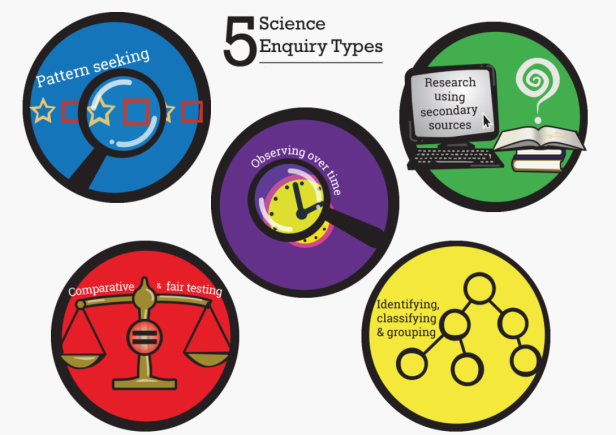
Lessons will allow for a wide range of scientific enquiry through practical experiences and carrying out investigations, either individually or collaboratively. The focus with the children will be for them to think and work like a scientist.
Working scientifically will be taught in every unit each half-term through the following approaches:
- Questioning, predicting and interpreting
- Asking scientific questions and using prior knowledge to suggest what will happen
- Pattern seeking and relationships
- Use equipment accurately t collect observations
- Record data appropriately and accurately
- Present data in bar charts and frequency charts
- Identify patterns in results
- Recognise the effect of sample size on reliability
- Carrying out time-controlled observations – observing changes over time ranging from minutes to months
- Draw and label what you observe
- Use equipment and take measurements accurately
- Create graphs and tables from your observations
- Think abut the effect of changing the time and number of observations
- Identifying, classifying and grouping
- Making observations to name, sort and organise items
- Use tests t sort and classify materials
- Use secondary sources to identify and classify things
- Make keys and branching databases with fur or more
- Lok for similarities and differences
- Undertaking comparative and fair testing - checking one variable to see its effect on another whilst keeping all others the same
- Make careful observations
- Gather, record, present and classify data in different ways: tables, labelled diagrams, drawings, keys and charts
- Use results t set up re-tests
- Take repeat readings
- Researching using secondary sources
- Evaluating – reflecting on the success of the enquiry approach and identifying further questions for enquiry
Scientific experiments will generally follow this sequence:
-
-
- Aim / question
- Equipment
- Method
- Fair Test (with knowledge of variables)
- Independent Variable – the variable that is being changed
- Dependent Variable – the variable we are measuring e.g. time using a stopwatch or growth of a plant using
- Controlled Variable – the variables we are keeping the same to ensure it is a fair test
- Prediction
- Results
- Conclusion/summary
-
- Teachers may choose to complete all aspects of an experiment above in one or two lessons or focus and record one aspect in greater detail.
- Experiments can be recorded in their science books or within the Class Floor book
SCIENCE CURRICULUM PLANNING
- Throughout Rockwell Green Primary School, science is taught as a discrete lesson or group of lessons as part of cross-curricular topic when appropriate.
- Teachers will use the key learning content in the DfE’s ‘Science programmes of study: key stages 1 and 2’ and the national curriculum as a starting point for their planning
- Long-term curriculum overviews will be used to outline the units to be taught within each year group. The science Curriculum is carefully planned over a two year cycle within Years 1 and 2, 3 and 4, and 5 and 6
- Medium-term planning will be used to outline the vocabulary and skills that will be taught in each unit of work.
- Short-term planning is the responsibility of the teacher. This is achieved by building on their medium-term planning, taking into account pupils’ needs and identifying the method in which topics could be taught.
- All lessons will have clear learning objectives, which are shared and reviewed with pupils.
ASSESSMENT AND RECORD KEEPING
At Rockwell Green primary School assessment is an integral part of the teaching process. The assessment of children’s work is on-going to ensure that understanding is being achieved and that progress is being made. Feedback is given to the children as soon as possible and will be guided by the school’s Feedback Policy.


