Design and Technology
At Rockwell Green Church of England school, through the subject of Design and Technology, we aim to provide children with an opportunity to be imaginative and creative for a purpose. The subject encourages children to become independent and creative problem-solvers, both as individuals and as part of a team. It enables them to identify needs and opportunities and to respond by developing ideas and eventually making products and systems. Through the study of Design and Technology they combine practical skills with an understanding of aesthetic, social and environmental issues. This allows them to reflect on and evaluate present and past Design and Technology, its uses and its impacts.
OUR AIMS - INTENT
Design and technology is a practical subject.
- We aim to prepare pupils to participate in tomorrow’s rapidly changing technologies.
- To provide opportunities for all the children to design and make quality products.
- To provide children with the opportunity to explore food and cooking techniques along with healthy eating and environmental issues within food production.
- To develop design and making skills, knowledge and understanding to the best of each child’s ability; using and selecting a range of tool, materials and components.
- To become creative problem solvers as individuals and members of a team.
- To develop an ability to criticise constructively and evaluate their own products and those of others.
- To help the children develop an understanding of the ways people in the past and present have used design to meet their needs. To reflect on and evaluate such techniques, its uses and effects.
- To prepare the children for living in a multi-cultural society by teaching consideration for other culture, this will be both important and beneficial.
To achieve our aims we ensure that the planned activities our children undertake are challenging, motivating, relevant and enjoyable. We give children confidence in their work by providing continual support and encouragement. The children are extended in their work in a way which develops their expertise. The children are provided with the very best resources possible, while constantly reviewing this provision
IMPLEMENTATION: TEACHING AND LEARNING
- At Rockwell Green Primary School we have the expectation that at least 3 Design and Technology projects will be engaged with per class each academic year.
- The projects will be broken down into 3 separate stages:
-
-
-
- Design
- Make
- Evaluate
-
-
-
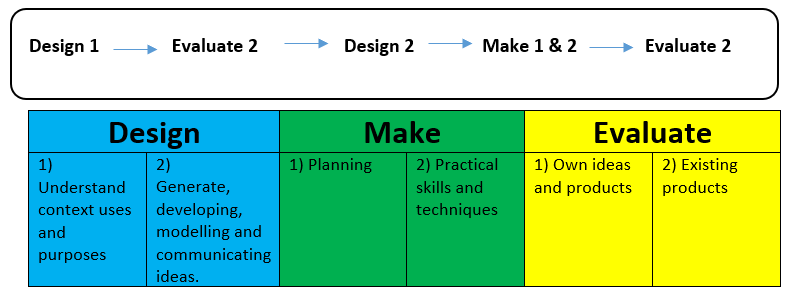
The stages will be taught following the sequence of learning below:
DESIGN
- The design stage can be completed as a whole class or on an individual basis decided on at the teacher’s discretion.
- The design stage will consist of studying an existing product issues relating to the current theme.
- The children/class will then decide on a product to make that will be an improvement on the product studied or will solve the issue addressed.
- The children will then plan out what their chosen product will look like, address the materials needed, generate, develop and communicate ideas to make the product and identify how to make the product.
MAKE
- The make stage will consist of making the product of the materials addressed in the design stage and following the outlined method.
- Children will use appropriate tools and materials to make their chosen product. This can be individually, in small groups or as a whole class decided on at the teacher’s discretion.
- Practical skills and techniques will be taught and used as outlined in the curriculum progression document.
EVALUATE
- The children will then evaluate their finished product either individually or as a whole class.
- Evaluation will also take place in the early stages of the teaching sequence. An existing product or products will be evaluated to see how successful they are, how they meet the aim/needs, or how they can be improved.
How these sections look in each Key stage is addressed below.
EYFS
The different aspects of the design and technology are encompassed within Creative Development in the Foundation Stage Curriculum, however elements can also be found in other areas of learning (Understanding the world, Physical development, Literacy and Mathematics). This curriculum lends itself to an integrated approach to learning. Pre-school and Reception teachers plan quality learning opportunities for design and technology using the Early Years Curriculum. There is an emphasis on independence and self-initiated learning, which enables foundation stage children to freely explore resources and pursue their own creative interests and talents in addition to the planned learning
experiences.
KEY STAGE 1
Design
- Design purposeful, functional, appealing products for themselves and other users based on design criteria.
- Generate, develop, model and communicate their ideas through talking, drawing, templates, mock-ups and, where appropriate, information and communication technology.
MAKE
- Select from and use a range of tools and equipment to perform practical tasks [for example, cutting, shaping, joining and finishing].
- Select from and use a wide range of materials and components, including construction materials, textiles and ingredients, according to their characteristics.
EVALUATE
- Explore and evaluate a range of existing products
- Evaluate their ideas and products against design criteria
TECHNICAL KNOWLEDGE
- Build structures, exploring how they can be made stronger, stiffer and more stable
- Explore and use mechanisms [for example, levers, sliders, wheels and axles] in their products
KEY STAGE 2
Design
- Use research and develop design criteria to inform the design of innovative, functional, appealing products that are fit for purpose, aimed at particular individuals or groups.
- Generate, develop, model and communicate their ideas through discussion, annotated sketches, cross-sectional and exploded diagrams, prototypes, pattern pieces and computer-aided design.
MAKE
- Select from and use a wider range of tools and equipment to perform practical tasks [for example, cutting, shaping, joining and finishing], accurately.
- Select from and use a wider range of materials and components, including construction materials, textiles and ingredients, according to their functional properties and aesthetic qualities.
EVALUATE
- Investigate and analyse a range of existing products.
- Evaluate their ideas and products against their own design criteria and consider the views of others to improve their work.
- Understand how key events and individuals in design and technology have helped shape the world.
TECHNICAL KNOWLEDGE
- Apply their understanding of how to strengthen, stiffen and reinforce more complex structures
- Understand and use mechanical systems in their products [for example, gears, pulleys, cams, levers and linkages]
- Understand and use electrical systems in their products [for example, series circuits incorporating switches, bulbs, buzzers and motors]
- Apply their understanding of computing to program, monitor and control their products
- We place an emphasis on the current theme of learning in each class addressed in the curriculum overview document.
- Teachers will identify a product/area to address within the theme of learning covering all three stages of the design: Design, Make, Evaluate.
- In each key stage, we will provide the children with examples (real products or images) to explore, discuss and evaluate.
- The children are encouraged to experiment and ask searching questions: ‘how does this work? How can I make it work better?
- We recognise the value and importance of DT being integrated with other subjects in the curriculum, and that this can be a powerful way to stimulate interest and consolidate learning.
- Through our medium and long term planning, we ensure that all relevant and effective cross-curricular links are made, especially with science and history.
DESIGN AND TECHNOLOGY CURRICULUM PLANNING
We have a detailed, skills-based curriculum, running across the whole school, which covers a two year rolling programme. This is broken down by the class teacher into half-termly over-views for each year-group. These documents are available for class teachers to consult on the staff shared server. These documents state the specific skills being taught and expected outcomes. The subject leader may discuss these documents on an informal basis with the class teacher.
ASSESSMENT AND RECORD KEEPING
Teachers assess children’s work in Design and Technology by making assessments as they observe them working during lessons. They record the progress that children make by assessing the children’s work against the skills outlined in the skills progression grid making an ‘On track/Not on track’ assessment. These assessments then form an annual assessment of on track or not on track against the skills outlined for each year group. This information is then passed onto next year’s teacher.